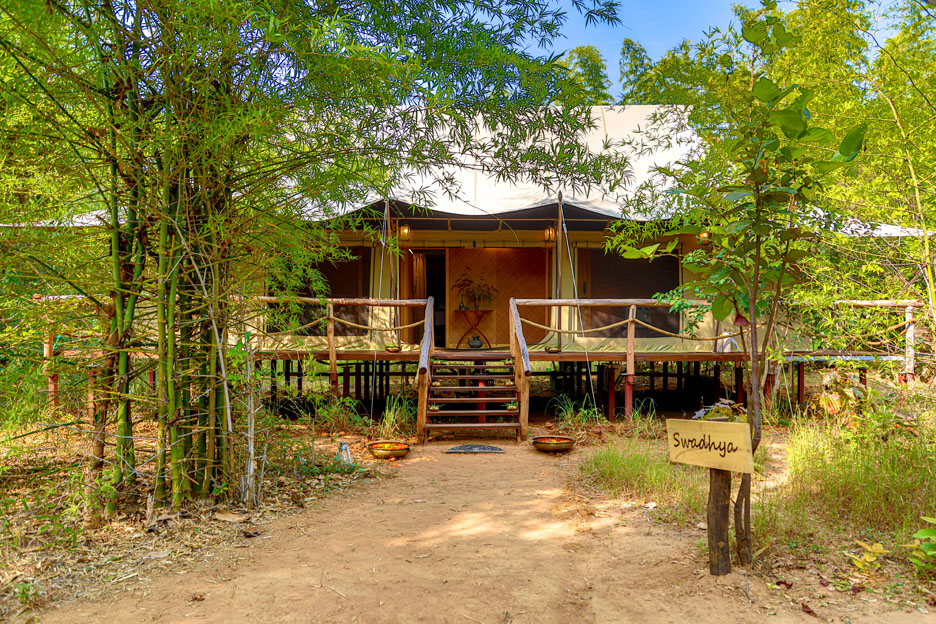
If Ranthambhore is a forest of lakes and ruins, Bandhavgarh is a forest of meadows and hills. Sal trees rise in tall, straight stands; bamboo grows thick on the slopes; and grassy meadows open up in the valleys where chital, sambar and gaur come to graze at dawn. Above it all stands the Bandhavgarh hill and its ancient fort.
The brother's fort
The name means "brother's fort". In local legend, Rama gave the hill to his brother Lakshmana to watch over Lanka. Historians have found inscriptions and rock-cut caves here going back about two thousand years, and the fort was held for centuries by a succession of dynasties before passing to the rulers of Rewa, who kept these forests as a royal hunting reserve.
At the foot of the fort lies Shesh Shaiya: a huge statue of Vishnu reclining on the coiled serpent Shesha, carved around the 10th century. A natural spring runs beneath it, said to be the source of the Charanganga stream that flows through the heart of the park. Seeing a tiger drink from that stream is one of Bandhavgarh's quiet wonders.
“Bandhavgarh's sal forest is so dense that tigers seem to appear out of nowhere — and disappear just as fast.”
Mohan, the white tiger
In 1951, Maharaja Martand Singh of Rewa captured a white tiger cub in the forests of his state. He named it Mohan. Bred at the palace in Govindgarh, Mohan became the ancestor of most of the white tigers later seen in zoos around the world. White tigers have not been recorded in the wild here for decades, but the story is part of the region's identity.
Bandhavgarh's wild orange tigers are famous in their own right. A tigress called Sita appeared on the cover of National Geographic in December 1997, and a dominant male called Charger was one of the best-known tigers of his time. Today the park is known for having one of the highest densities of tigers in India.

Zones and timing
The core is divided into three zones. Tala is the most famous, with the fort, Shesh Shaiya and the open Chakradhara meadow. Magadhi and Khitauli are quieter and often very productive for sightings. Like Ranthambhore, safaris run in the early morning and late afternoon, and permits are limited — so we plan them well ahead.
March to May brings the best sightings as the forest dries out and tigers stay close to water. Winter mornings are cold and misty but very beautiful, and October and November show the forest at its greenest just after the monsoon.
- Combine Tala with Magadhi or Khitauli for different landscapes.
- Look up as well as down — the park is excellent for birds, including the crested serpent eagle.
- Visit Shesh Shaiya on a morning drive in the Tala zone.
The Field Notes · Newsletter
New stories from the wild, straight to your inbox.
Only new Journal stories — no spam, unsubscribe any time.